
Salvator merianae
Meet Ursula.
Ursula is an Argentine black & white tegu: intelligent, powerful, food-motivated, and dependent on large, carefully managed daily care.
Search tegu answers →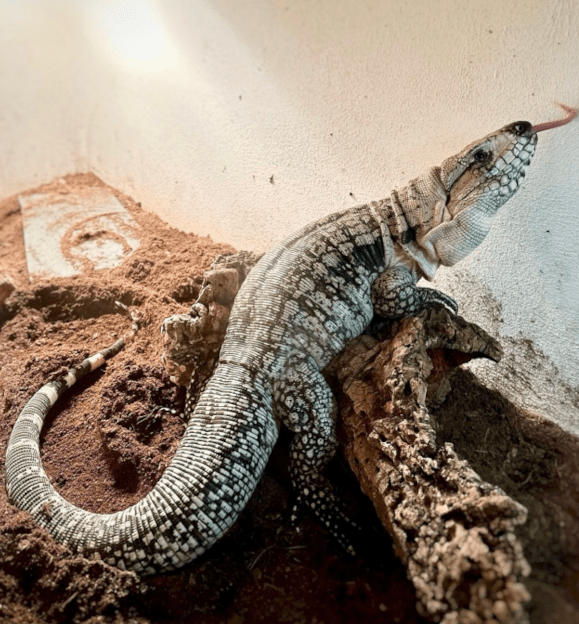
Room to burrow. Heat to thrive.
Adult tegus require a room-scale escape-proof enclosure, a 110–120°F basking surface, a cooler retreat, strong UVB, roughly 70–80% humidity with ventilation, and deep suitable substrate. Their varied diet and supplement plan should be reviewed by an experienced reptile veterinarian.
Enclosure & Climate
Tegus need 8×4-foot or larger enclosures with secure walls, a thermal gradient, humid hides, and 12–14 hours of UVB. Deep substrate allows natural burrowing and shedding.
Diet & Wellness
Omnivorous meals of whole prey, insects, eggs, and produce, plus calcium and vitamin D support, keep growth steady. Annual reptile veterinary exams catch early care-related issues.
Behavior & Handling
Food-motivated and curious, tegus can learn to tolerate calm, consistent handling. Consistent routines and clear enclosure boundaries reduce stress and defensive responses.
Commitment & Safety
Tegus live 15–20 years, grow over 4 feet, and need daily care, strong biosecurity, and local permit checks. Their strength and feeding response demand experienced handling.
Tegu knowledge
Tegu care questions
Turn broad seasonal and weather care advice into a workable routine for argentine tegus.
Argentine Tegus · seasonal and weather careWhat common myths lead to poor care for argentine tegus? →Where good myths and responsible ownership starts for argentine tegus—and which shortcuts commonly cause trouble.
Argentine Tegus · myths and responsible ownershipHow do I choose an ethical source for argentine tegus? →Build a safer, more realistic ethical sourcing and rescue plan for argentine tegus.
Argentine Tegus · ethical sourcing and rescueWhat lighting do argentine tegus need? →Start with how argentine tegus live, then build better decisions about lighting and ultraviolet exposure.
Argentine Tegus · lighting and ultraviolet exposureWhat kind of carrier is safe for argentine tegus? →Learn how the biology of argentine tegus changes everyday decisions about carriers and transport containers.
Argentine Tegus · carriers and transport containersHow can I recognize boredom in argentine tegus? →Explore the habitat, nutrition, behavior, and safety details behind boredom and under-stimulation for argentine tegus.
Argentine Tegus · boredom and under-stimulationWhen does illness in argentine tegus require a veterinarian? →Turn broad health monitoring advice into a workable routine for argentine tegus.
Argentine Tegus · health monitoringHow can I train and handle argentine tegus without force? →Learn how the biology of argentine tegus changes everyday decisions about training and handling.
Argentine Tegus · training and handlingHow should food for argentine tegus be stored and prepared? →Build a safer, more realistic food storage and feeder safety plan for argentine tegus.
Argentine Tegus · food storage and feeder safetyWhat substrate or bedding is safe for argentine tegus? →Make substrate and bedding decisions that fit the body, behavior, and lifetime of argentine tegus.
Argentine Tegus · substrate and bedding